What a follow-up email is for
A follow up email has one job: make the next step easy. It is not there to remind someone that they owe you a reply. It is there to give them a reason, and a simple way, to answer.
People rarely ignore an email on purpose. A business owner reads your proposal between jobs, means to reply that evening and then forgets. A short, useful follow-up is a favour to them. A pushy one becomes the reason they never reply.
This guide is for business, sales and client emails: the ones agencies and freelancers send to local business owners after a first email, a call, a proposal or a quote. If you are after an interview follow-up, the same principles apply, but the examples here are about winning and keeping clients.
How to write a follow up email in five steps
1. Reply in the same thread
Hit reply on your last message rather than starting a new email. The reader sees what you sent before without searching, and your subject line is already familiar.
2. Name what you are following up on
One line is enough: "Following up on the quote I sent Monday." Do not apologise for writing, and skip "just checking in", which tells the reader nothing.
3. Add one new thing
This is what separates a good sales follow up email from a nag. Add a detail you noticed on their website, an answer to a question they are likely to have, a date that matters ("the price holds for 30 days"), or a smaller version of your offer.
4. Ask one easy question
Make the reply a single word or a single line. "Would Thursday or Friday work?" is easier to answer than "Let me know your thoughts." Ask one thing, not three.
5. Keep it short, and plan when to stop
Aim for under 100 words; most owners read email on a phone. Before you send the first follow-up, decide how many you will send. Two or three after the first email is usually enough, then a closing email.
When to send it
Knowing how to send a follow up email is mostly about timing. Too soon feels pushy; too late and they have forgotten the context. These gaps are sensible starting points, not rules:
| Situation | First follow-up | Next one | When to stop |
|---|---|---|---|
| No reply to a first email | 3 business days | 4 to 7 days later | After 2 or 3 follow-ups |
| After a call or meeting | Same day or next morning | Only if they owe you something | When the next step is booked |
| After a proposal | 2 to 3 business days | The day after their decision date | Close the loop after 2 to 3 quiet weeks |
| After a quote | 2 to 3 business days | 1 week later | When the quote expires |
| Waiting on their input | A day before the deadline | The day after it | When you get it |
| Unpaid invoice | On the due date | 7 days overdue | Move to a phone call |
Send in their working hours, not yours. A roofer may read email at 6am before the first job; a dental practice manager may read it at lunch. If you know when they replied before, aim for the same time of day.
Subject lines for follow-ups
In most cases, keep the original subject and reply in the thread. When you do need a new subject, make it plain and specific, so it reads like a work email rather than marketing:
12 professional email follow-up examples
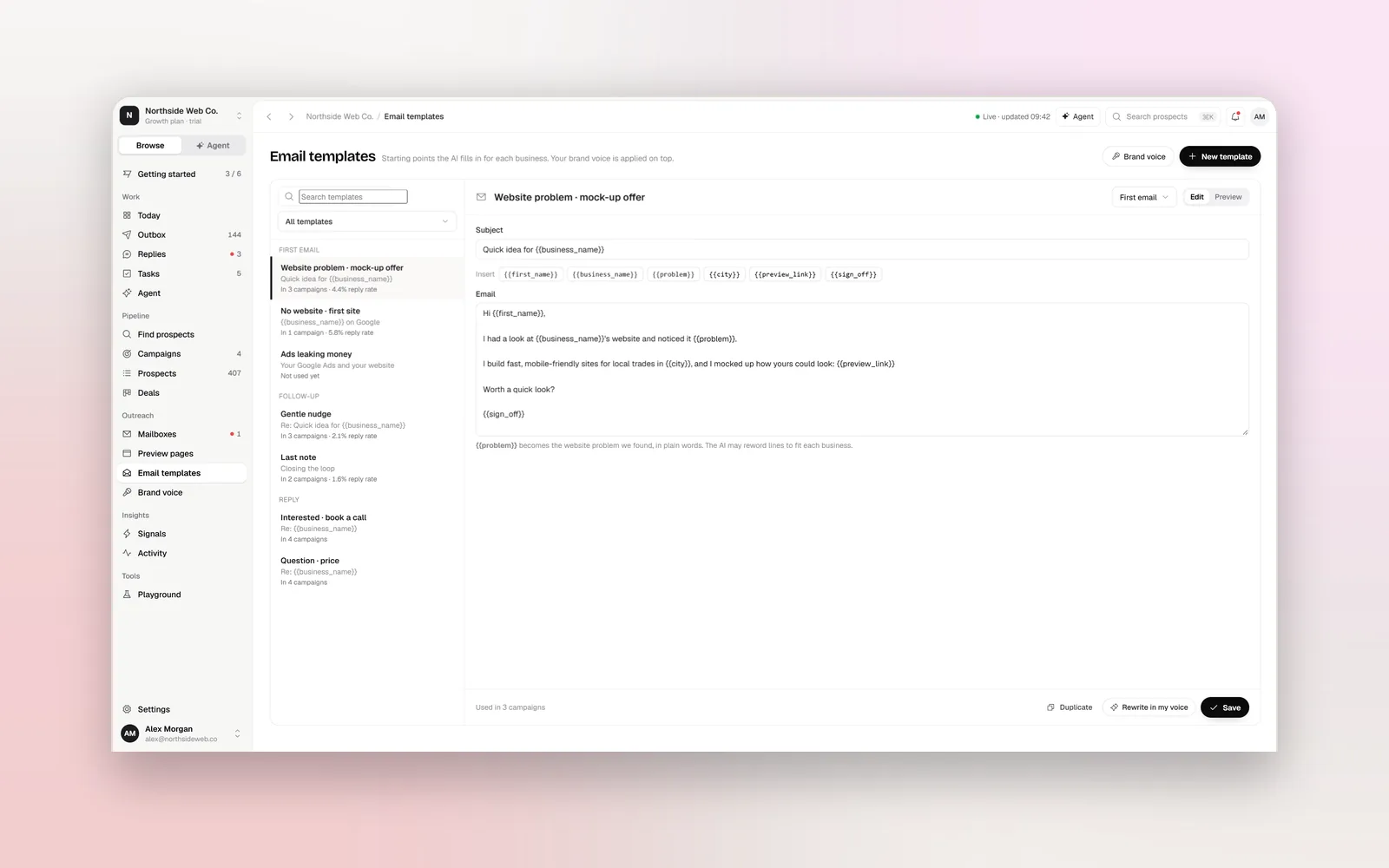
These professional email follow up examples are written for agencies and freelancers working with local businesses. Use any of them as a follow up email template: swap the names and details, and keep the shape.
Follow up email after no response
The first nudge can be very short. The second should add something new, because a follow up email when you haven't heard back works best when it gives the reader a fresh reason to reply.
Hi Dana,
Just bringing this back to the top of your inbox. Would a 15-minute call on Thursday or Friday work to talk through the mobile booking form?
Thanks, Sam
Hi Dana,
One more thing I noticed since my last note: the phone number on your contact page isn’t tappable on a phone, so mobile visitors have to copy it by hand. That’s a quick fix either way.
Is the website something you’re looking at this quarter, or should I check back later?
Best, Sam
After a call or meeting
Send these the same day. Summarise what you heard in their words, confirm the next step and who owns it, and ask them to correct anything you got wrong.
Hi Marcus,
Thanks for the time today. My notes: you want more quote requests from the Westside, the current site is hard to update, and you’d like to launch before spring.
Next step on my side: a one-page outline with two options by Wednesday. Did I miss anything?
Talk soon, Priya
Hi Ellen,
Good to meet you on Tuesday and see the new showroom. As promised, here are the three photos of competitor homepages we talked about.
If it helps, I can sketch how yours could look with the showroom photos up front. Want me to?
Regards, Tom
After a proposal
Proposals stall because someone else needs to see them, or because a question is stopping them. Offer to answer questions and use any date they gave you.
Hi Dr. Patel,
Checking the proposal reached you and made sense. Happy to walk through it on a short call, or answer questions by email if that’s easier.
Is there anything you’d like changed before you share it with your partner?
Best, Aisha
Hi Dr. Patel,
You mentioned you’d decide by the end of the month, so I wanted to check in. If the timing has moved, no problem: just let me know roughly when to come back to you.
Thanks, Aisha
After a quote
A quote has natural follow-up hooks: when the price expires and when you can start. If price is the issue, a smaller first phase often keeps the conversation going.
Hi Rob,
Following up on the quote I sent Monday. The price holds for 30 days, and we can start the week of the 12th if that suits you.
Any questions on the line items?
Cheers, Luis
Hi Rob,
If the full quote is more than you planned, we could split it: the homepage and contact page now, the service pages later. That brings the first invoice down to about half.
Would a smaller first phase help?
Luis
Polite reminders
Reminders work best when they are warm, specific and make the task easy, such as a link, an attachment or an offer to help.
Hi Jo,
A gentle reminder that we still need the hosting login to start on Monday. If it’s easier, I can jump on a five-minute call and walk you through finding it.
Thanks so much, Nina
Hi Greg,
A friendly reminder that invoice 1042 for the site launch is due today. I’ve attached it again with the payment link.
If it’s already on its way, please ignore this, and thank you.
Best, Nina
Hi Carla,
Kim introduced us last week and I didn’t want to let it slip. She mentioned you’re thinking about online booking for the salon.
I’ve set it up for two salons nearby. Would a short call next week be useful?
Best, Dev
Closing the loop
The last email in a sequence should be friendly and final. It often gets a reply because it removes the pressure, and if it does not, you can move on with a clear conscience.
Hi Dana,
I haven’t heard back, so I’ll assume the website isn’t a priority right now, which is completely fine. I’ll stop following up.
If it comes back onto your list, just reply to this email and I’ll pick it up from there.
All the best, Sam
Sales follow-up mistakes to avoid
Most follow-ups that go unanswered make one of these mistakes:
- “Just checking in”It says nothing new. Add a finding, an answer or a smaller option.
- Guilt trips“I’ve emailed you three times” makes replying feel like an apology.
- A new thread every timeReply in the original thread so they can see the context.
- Several asks at onceOne question per email. Two make it easy to answer neither.
- Long paragraphsMost follow-ups are read on a phone. Keep it short.
- No end dateDecide in advance when you will stop, then send a closing email.
And one rule that is not about style: when someone asks you to stop, stop, and take them off any list you are sending from.
Follow-ups in cold email
Everything above assumes the reader knows you: you have spoken, met or sent them something they asked for. Cold email is different. The owner did not ask to hear from you, so each follow-up has to earn its place with something new about their business, and the rules on opt-outs and sender details apply to every message.
If that is the situation you are in, read the companion guide on cold email follow-up. It covers day 3 and day 7 follow-ups, what to add in each and when to stop.
Automating follow-ups with WarmyBiz
Writing two follow-ups for one client is easy. Writing them for 50 local businesses you contacted this week, and remembering to stop when someone replies, is where things slip.
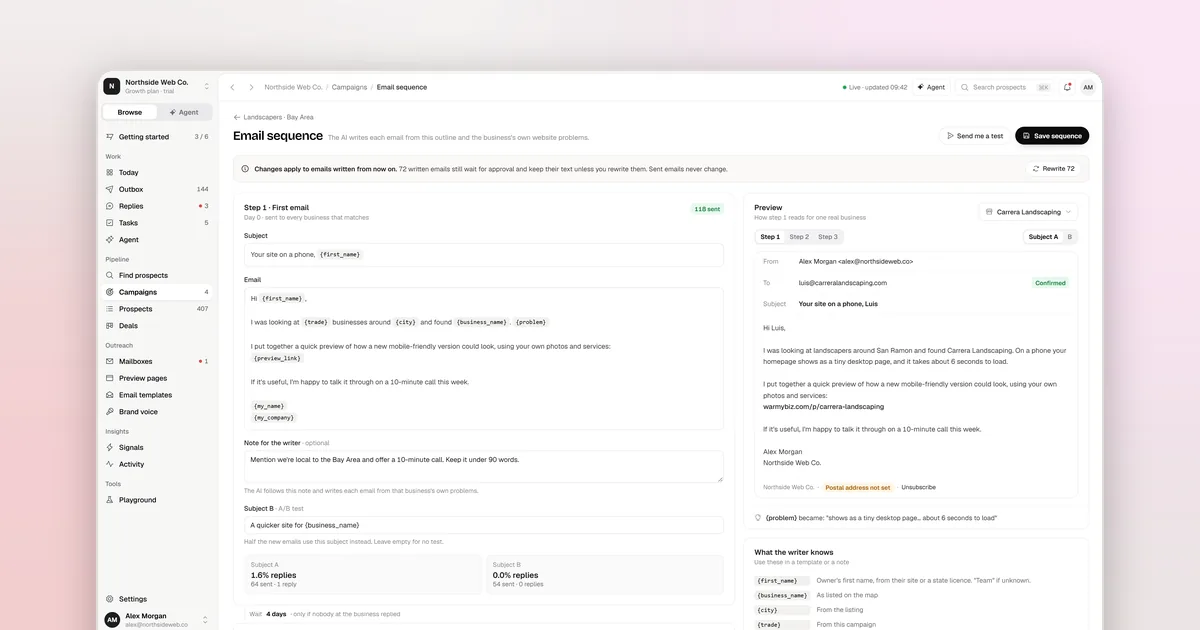
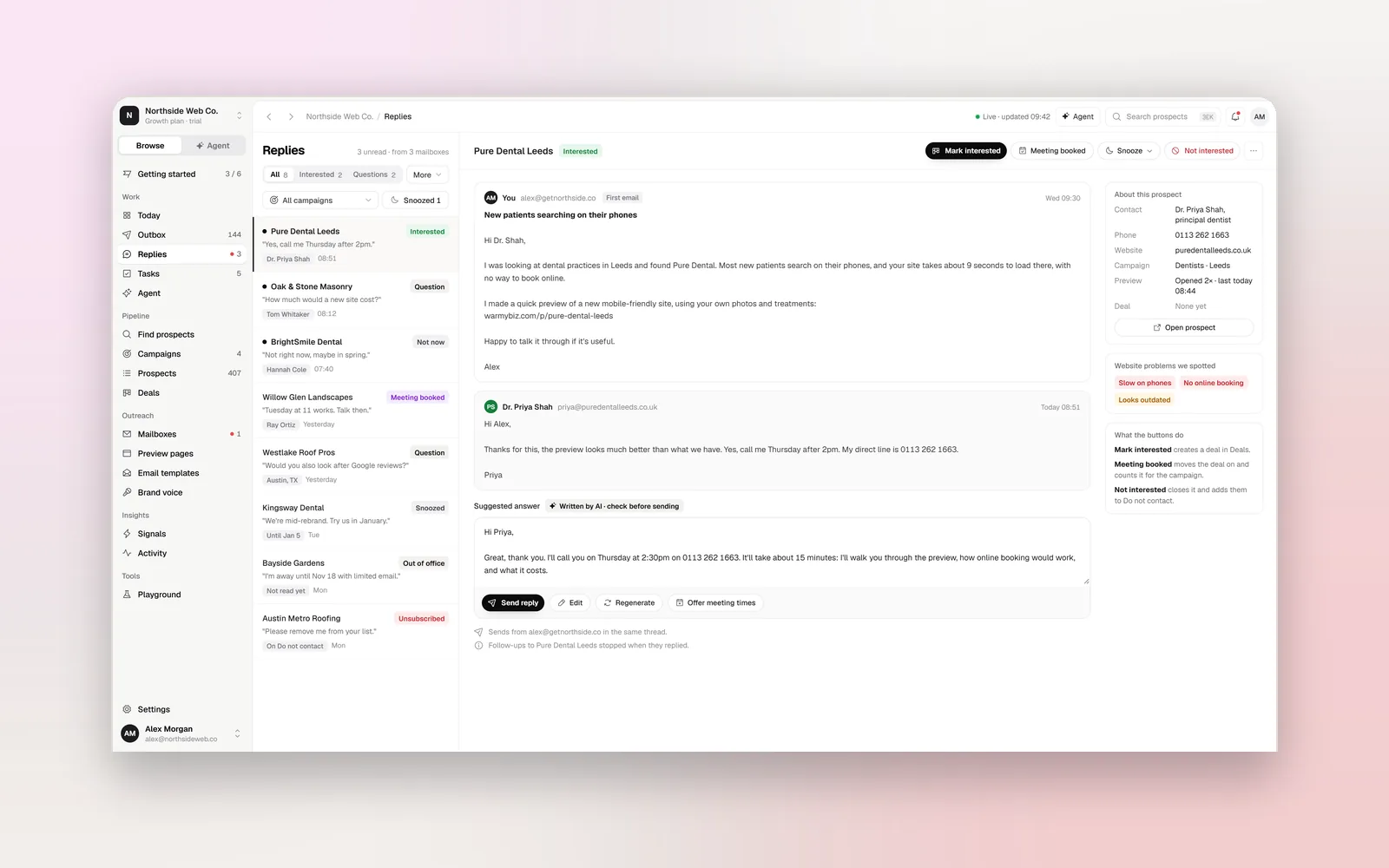
WarmyBiz runs sequences of up to five steps, by default on day 0, day 3 and day 7. Each step is written in your brand voice, and you can approve it before it sends. A reply, a bounce or an unsubscribe stops the sequence. If a prospect opens the personal preview page you sent, WarmyBiz alerts you and moves their next follow-up sooner. The AI Follow-up Agent page shows how it works.
Whether you use a tool or a calendar reminder, the method is the same: same thread, one new thing, one easy question, and a clear point at which you stop.